

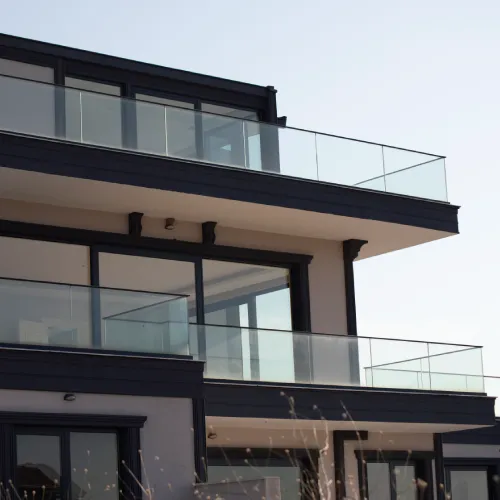
Modern architecture represents a design philosophy built on the principles of transparency, lightness, and uninterrupted views. Glass railing systems are one of the strongest complements to this approach. Eliminating the visual weight of traditional metal or solid barriers, glass railings define the boundaries of a space while maintaining a sense of spaciousness. The preference for these systems is increasing every year, especially in residential projects, residences, shopping malls, and commercial buildings.
In new-generation architectural projects, glass railings are not only a safety element but also considered an integral part of the facade design, balcony aesthetics, and interior continuity. Minimal profiles, concealed mounting details, and linear forms make it possible to meet safety standards without disrupting the architect’s design language. At this point, technical criteria such as profile geometry, glass thickness, anchoring system, and load-bearing capacity should be evaluated together with aesthetics.
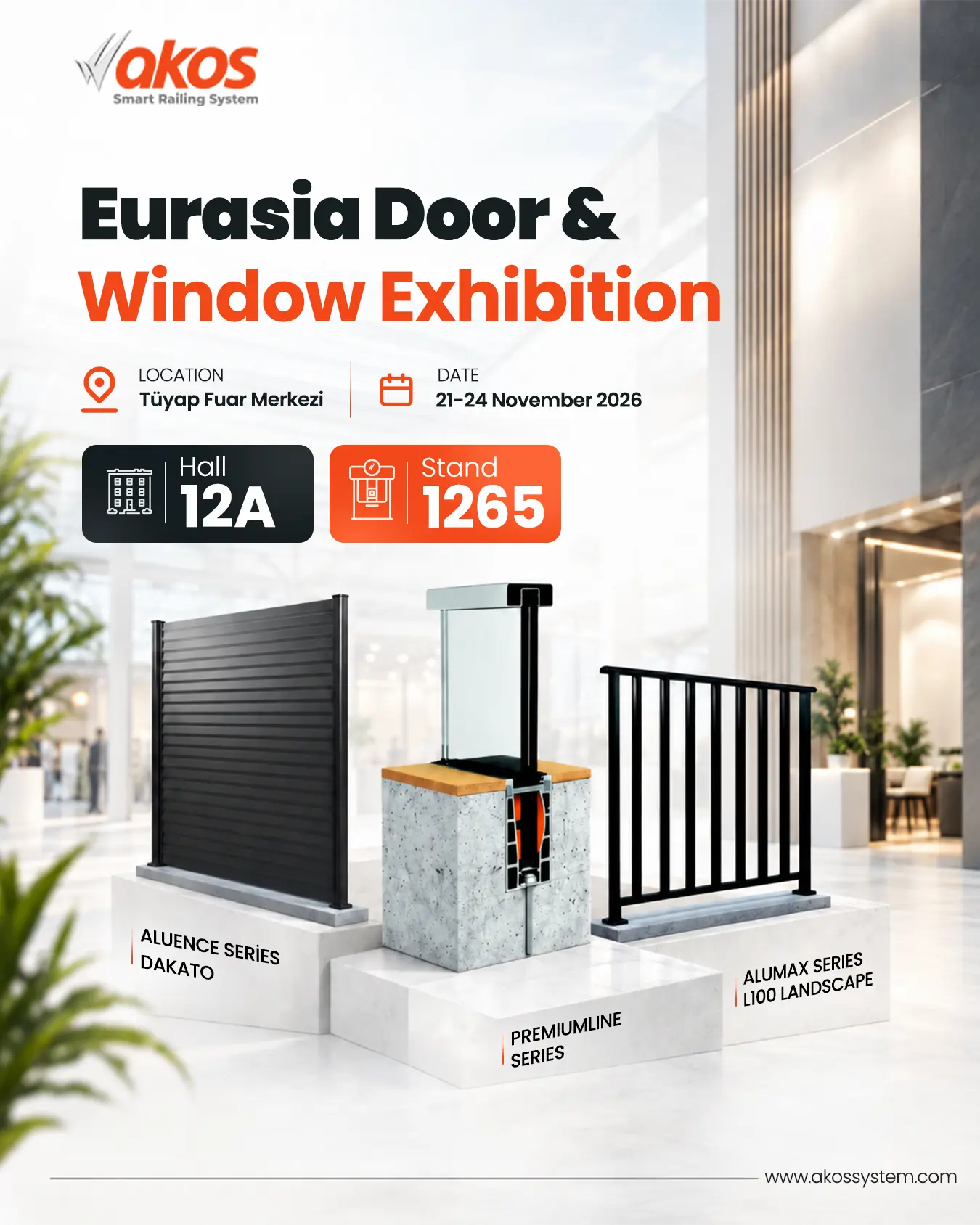
In recent years, systems with low profile heights and fixed from the base have come to the forefront. These solutions, which maximize the field of view, provide a significant advantage in projects with panoramic views. The PREMIUMLINE PL10 and PREMIUMLINE PL20 systems developed in this category stand out with their simple and robust profile structure, meeting the expectations of modern architecture. Thanks to their slim profile design, visual integrity is maintained while high strength values ensure safety standards are met.
In projects requiring higher load-bearing capacity and different application scenarios, system diversity becomes crucial. In commercial buildings, areas with high pedestrian traffic, or wider openings, profile strength and glass fixing technology are decisive factors. The PREMIUMLINE PL30 and PREMIUMLINE PL31 models in this segment offer optimized solutions for projects requiring high performance. They combine safety and aesthetics in a balanced way for both interior and exterior applications.
Another trend is the detail concealment approach. The absence of visible screws, anchors, and fasteners ensures a seamless perception of the glass surface. This is particularly preferred in luxury residential projects and prestigious commercial buildings. At the same time, modular assembly systems shorten application time, increasing site efficiency.
Akos System develops solutions that address both design expectations and engineering requirements in modern architectural projects. Thanks to its project-based approach, technical support, and system diversity; From balconies to terraces, from stairwells to gallery spaces, we offer aesthetic and safe glass railing systems for a wide range of applications. In contemporary architecture, transparency is not a preference but a standard; choosing the right system makes this standard sustainable.
Glass Balustrade Trends for 2026
Six details shape most architectural glass balustrades in 2026, from villas to hotels, and each one below is tied to a system we make. Akos has manufactured aluminium railing and glazing systems in Konya, Turkey since 2006 and exports to more than 50 countries.
| Trend | Akos system | Indicative price, EXW |
|---|---|---|
| Black and bronze anodised profiles | Endureline and Premiumline channels, A60 posts, handrails | Kit price band, colour approved on a sample |
| Frameless base channels | Endureline, Premiumline, Safeline | 140-240 EUR/m, residential 10+10 PVB |
| Low iron extra clear glass | Any channel or spigot kit | Quoted as a glass option |
| SGP glass in public areas | Side-mounted channel with 12+12 SGP | 260-420 EUR/m |
| Laser cut panels with glass | Sarajevo, Zurih or your own pattern | 110-220 EUR/m for the panels |
| Slim handrails and top caps | Round or square aluminium handrails, caps for glass | Included in the kit price |
Black and Bronze Anodised Profiles
Dark frames now match black windows and facade details. A black or bronze base channel and handrail frame the glass like a window. We supply Qualanod anodised finishes and Qualicoat powder coating, with RAL 9005 black and RAL 7016 anthracite the most requested dark colours. Approve bronze or black anodising on a real sample, and allow 25-40 working days for a custom finish.
Frameless Base Channels
Posts are disappearing from balconies and terraces. Endureline EL50 and EL51 come in continuous 6 m lengths for 8+8 laminated glass, so long runs have fewer joints. Premiumline offers a Y design for slab edges, an F design with hidden screws and a rear profile that tucks behind facade cladding. Safeline SL11 uses short 30 cm bases, each with its own adjustment, for uneven slabs. See our frameless glass balustrades.
Low Iron Extra Clear Glass
Standard float glass has a green tint that shows on the edges of thick laminates such as 10+10 and 12+12. Low iron glass removes most of that tint, so the balustrade reads as clear against white walls or dark frames. Smoked, tinted and frosted glass are also available on request.
SGP Laminated Glass in Public Areas
Hotels, offices and public buildings are moving from PVB to SGP interlayers. SGP is much stiffer and keeps more of its shape after breakage, which is why it is the usual choice where the top edge stays free. Our hospitality kit uses 12+12 SGP in a side-mounted channel. Compare both in our guide to PVB vs SGP laminated glass.
Laser Cut Panels Combined with Glass
Architects now mix privacy and view on one facade, with laser cut aluminium panels where neighbours look in and glass where the view opens up. Sarajevo, Zurih or a pattern cut from your vector file are powder coated in the same RAL as the glass channel, so the two read as one design. More patterns are on our laser cut railing page.
Slim Handrails and Top Caps
Handrails are getting thinner or disappearing. A slim round or square aluminium handrail ties the panels together and protects the top edge of PVB glass. Leaving the handrail off needs SGP glass, the engineer’s approval and local rules that allow it, and on stairs codes normally ask for a handrail.
Glass Balustrade Specification Checklist
- Use and load. Home, office or public area, with the line load checked under Eurocode 1, or BS 6180 in the UK.
- Fixing. Floor-mounted channel, side-mounted channel or spigots.
- Glass build-up. 10+10 PVB for most homes, 12+12 SGP for public areas and free top edges.
- Glass type. Clear, low iron, smoked, tinted or frosted.
- Height. To your local code, set on the drawing.
- Finish. RAL powder coat or anodised, approved on a sample.
- Top edge. Handrail, top cap or free edge.
Glass Balustrade Trends FAQ
Are glass railings popular in high-end homes?
Yes. In high-end homes the usual choice is a frameless base channel with 10+10 PVB glass, often in low iron glass with a black or anthracite channel. Our residential kit costs 140-240 EUR per linear metre ex works, excluding VAT.
What is the most modern type of glass balustrade?
A frameless balustrade with the glass set in a floor-mounted or side-mounted base channel and no posts. Where the engineer and local rules allow, SGP laminated glass lets you leave out the handrail for the cleanest line.
Which profile colours suit a modern glass balustrade?
Black RAL 9005 and anthracite RAL 7016 are the most requested, with bronze or black anodised finishes for premium projects. Approve any anodised shade on a sample before production.
When do I need SGP glass instead of PVB?
Choose SGP for hotels, offices and public areas, for free top edges without a handrail and for glass edges open to the weather. For homes with a handrail, 10+10 PVB is usually enough, confirmed by the project engineer.
Is low iron glass worth it for a balustrade?
It pays off on thick laminated glass, where the green edge tint of standard glass is most visible, and next to white walls or dark frames. It costs more than clear glass, so we quote it as a separate option.
Specify Your Glass Balustrade
Send drawings or dimensions, the use of the space and your preferred finish. We reply with a system proposal and an ex works price. Request a quote.